

Through the Murk
How to sensemake Vietnam without pretending the fog was never there

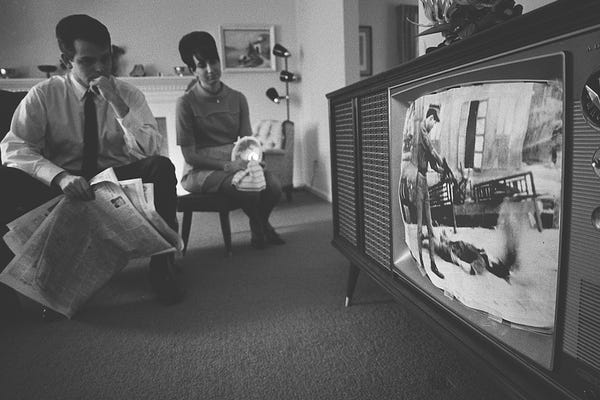
We try to talk about history, America, and purpose a lot in our home.
Partly that is because of my work, so the kids understand that I’m not home for something important. Partly it is because I want my kids to understand that all the privileges to complain and comforts to enjoy were first born of ideas and then earned through extraordinary leadership. They inherited a country, a story, and a responsibility. So when we talk through a war, or a president, or a newsmaking event, or something Dad is working on, I try to be transparent about two things: my biases and my limits.
I also tell them what I do not know and how I’m trying to understand.
And I often find myself asking a question out loud, partly for them and partly for me: are we trying to understand the people of another time on their own terms, or are we just flattering ourselves with the moral vocabulary of the 2020s? The latter is a common bug of human nature, and it is an especially common problem in modern life. My friend Juan Zarate calls this the “conceit of chronology.”
That question has been with me as I have tried to make sense of Vietnam.
It is tempting to march into a subject like this carrying a few modern slogans and a lot of retrospective confidence. We kind of know how the war ended. We know what’s been said about it. We have an idea for how it is remembered. That can help. It can also make us lazy.
One thing I always try to remember is that people in the moment are often later judged to be on the wrong side of history, and they often contradict themselves as the lessons of history unfold. More bluntly, people were often wrong then, and we are probably wrong about a lot now. Sometimes it is because people lack information and knowledge that gets built over time. Sometimes because they are ruled by fear, fads, or tribal loyalty. Often because they do not make the effort to guard emotion, widen perspective, and test their own assumptions. To be clear, while I write “they” and “people,” I apply that to “me.”
American history is full of that. During the American Revolution, Loyalists alone made up roughly a third of the colonial population, and many others tried to stay neutral. Before the Civil War, abolitionists were still a bitterly resented minority, and free whites were more often than not indifferent to their message. Hitler and Imperial Japan were slaughtering well before the United States entered World War II. During the civil-rights movement, Martin Luther King Jr. wrote that the white moderate was “the Negro’s great stumbling block,” a reminder that apathy and hesitation can enable open hostility.
Even our judgments of presidents keep changing. Harry Truman was deeply unpopular in his final years, yet now sits near the top tier of presidential rankings. George W. Bush left office deeply unpopular too, yet later looked steadier and more refreshing to many Americans than he did at the time.
That does not mean truth is impossible. It does mean hindsight can be both gift and cheat. It can help us see more, but it can also make us smug. It can tempt us to turn complicated people into cardboard villains and morally tangled moments into easy slogans.
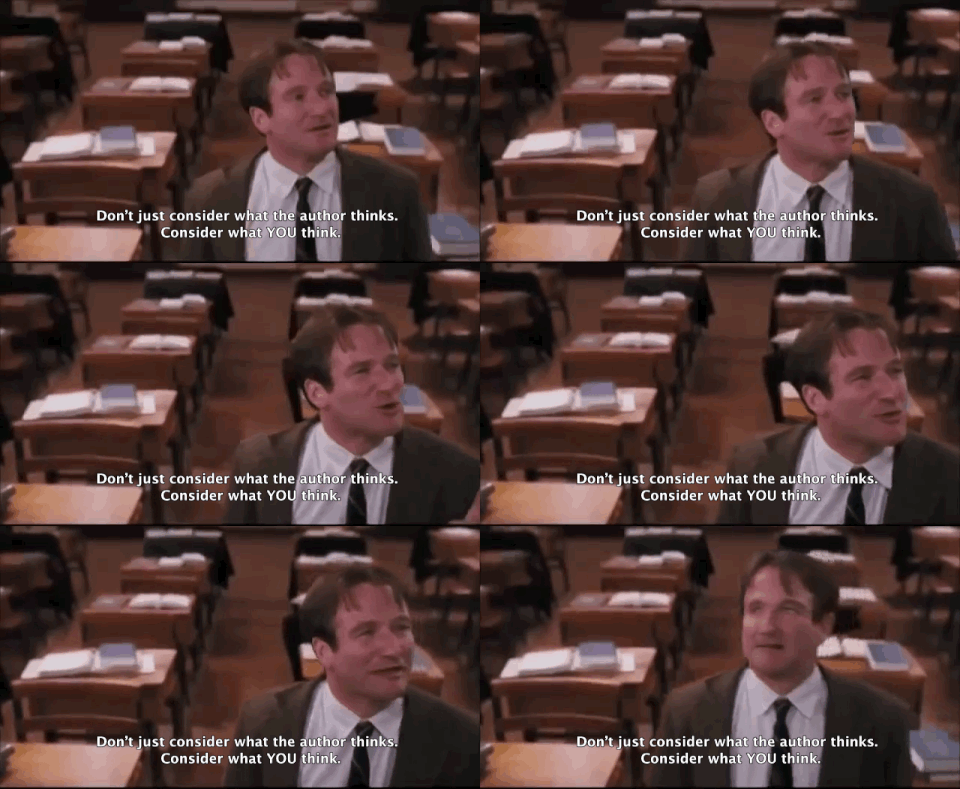
Perspective and grounding
I want to look at Vietnam from three vantage points: backward from where we stand now, inside the time as people experienced it then, and forward toward what the competing interpretations of the war have done to our politics, our memory, and our moral imagination about our own future, which we still control. That, at least, is the process I hope gives my kids some guideposts too: be honest about your priors, learn the context, change where you sit when you need another angle, and only then decide more carefully where you stand.
That brings us to the schools of thought about the Vietnam era.
Conventionally, the first two are called the orthodox and revisionist schools. Fair enough. But this is my Substack, and for my purposes, I want to label them a little differently: the tragedy school, the Cold War realist school, and the Vietnam-centered school. I put the Vietnam-centered lens third not because it is the destination or the superior answer, but because it helps round out the picture after the older American debate has been clearly named. Vietnam school matters here less as a final standard than as a demanding case study in how context, memory, and moral judgment can get muddled together.
The first wrong move is to assume there is one obvious story.
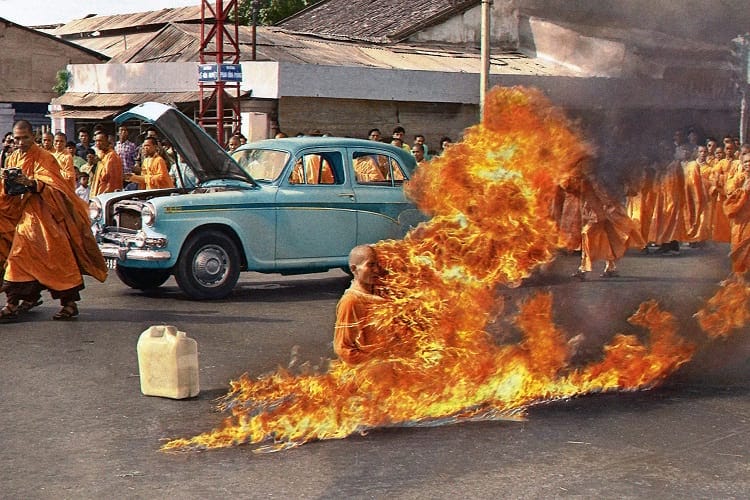
Vietnam keeps resisting that. It was a colonial struggle, a civil conflict, a Cold War contest, an American war, and later a national wound fought over through memory and ideology. Any interpretation that turns all of that into one clean moral script is probably telling you more about the interpreter than the war. The schools of thought are useful, but they are not revelation.
The tragedy school
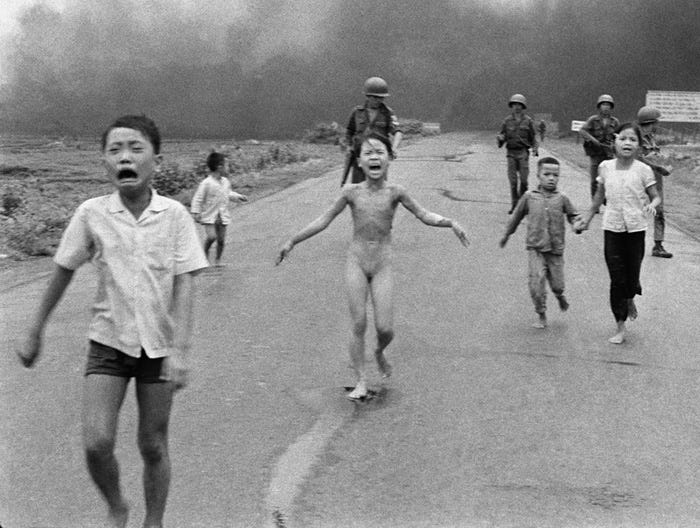
What scholars usually call the orthodox school became the prevailing outlook first, especially in popular memory and much of the academy. I think of it as the tragedy school because it prioritizes the pain, seeing the war as fundamentally misguided, unwinnable, and made worse by American intervention. In this view, the United States was trying to prop up an artificial South Vietnamese state against a stronger current of nationalism and revolutionary legitimacy. American power made the war bigger, bloodier, and more futile.
There is real force in that argument. It explains American overconfidence. It explains the fragility of the South. It explains the mismatch between political goals and military means. It also helped puncture a lot of official evasion that deserved puncturing.
Still, this school has blind spots of its own. It can romanticize Vietnamese communism. It can minimize anti-communist Vietnamese agency. It can reduce South Vietnam to little more than an American puppet, when the South had its own ambitions, internal debates, constituencies, and claims to legitimacy. It also too easily collapses the American view of the world into the French colonial view, as if Washington were merely inheriting Paris’s empire in another accent. It was not. America inherited colonial debris, yes, but its strategic and moral framework was not simply the French one in translation.
Too often, the old tragedy-school habit quietly turned “the Vietnamese” into the Vietnamese communists and treated everyone else as secondary.
The Cold War realist school
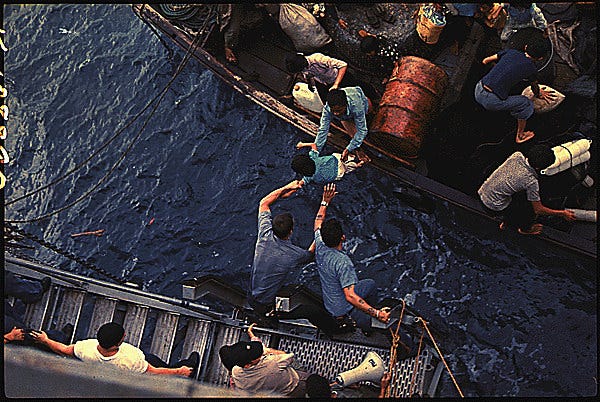
What scholars usually call the revisionist school pushed back against that consensus. I prefer Cold War realist because the strength of this view is not mere contrarianism. It is its insistence that the communist threat was real, that American concerns were not invented out of reckless paranoia, and that real progress was made, however uneven and ultimately fragile. Seen that way, treating the entire war as doomed from the start is not just too simple. It can be emotionally charged and intellectually lazy.
This school reminds us of the context of the time and appreciates the power of ideas. Mao had won in China. Korea had already shown that communist aggression was not theoretical. Soviet coercion and expansion were facts of the age, not fever dreams. We now know Mao’s Great Leap Forward alone cost tens of millions of lives, and more broadly the communist world had already shown a staggering capacity for coercion and death. All of this happened while World War II was still very visible in the rearview mirror. The domino theory may have been too simply applied, but it did not sprout from nowhere.
That is one reason the Cold War realist lens matters. It refuses to treat anti-communism as merely a mask for imperial vanity. It insists there were real threats, real precedents, and real reasons to worry about what communist victory would mean.
To my mind, it also sees the central moral and geopolitical reality more clearly than the tragedy school does. The question of whether the war should have been fought is not identical to the question of whether American and South Vietnamese forces were simply losing it. Those are different questions. At key moments, especially Tet, American and South Vietnamese forces were not losing militarily at all. The Tet Offensive was a crushing tactical defeat for the North, even as it became a political and psychological blow to the United States. That is precisely why this school keeps pressing on rules of engagement, sanctuaries, domestic political will, and the widening gap between battlefield results and public narrative. It raises real questions about whether politicization and schizophrenic restraint undermined the possibility of translating military advantage into a durable outcome.
And this is where moral judgment gets harder, not easier. Once the communist threat is treated as real, coercive, and historically grounded, judgment cannot stop at American arrogance or error. It has to reckon with the character of the thing America and South Vietnam were trying to resist.
It also reopens questions that the tragedy school can close too quickly: whether the war was more understandable than later generations like to admit, whether communist victory was morally more costly than many western retellings allow, and whether American failure was at least partly a failure of strategy, political will, and leadership rather than mere illegitimacy.
Still, this school has temptations too. It can turn into a geopolitical Uncle Rico and drift into a “we could have won if only…” confidence that the historical record does not fully support. It can understate the depth of South Vietnam’s weaknesses. It can treat the war too much as a strategic puzzle and not enough as a struggle among competing Vietnamese futures.
That is the angle I find most interesting about its limits: it can be right about the threat and still too dependent on the ifs.
The Vietnam-centered school
A third lens helps round it out even further. Call it Vietnam-centered, post-revisionist, or simply more serious about Vietnamese complexity.
This approach helps ask good questions. What did South Vietnamese actually believe they were defending? How much autonomy did the southern insurgency really have, and when? How should nationalism and communism be weighed against each other in the North? How did region, religion, class, family, and memory shape the war from inside Vietnam rather than only from Washington?
This is not “the Vietnamese view,” singular. There was no single Vietnamese perspective on the war. There were communist and anti-communist Vietnams, northern and southern Vietnams, Buddhist and Catholic Vietnams, urban and rural Vietnams, family loyalties and political loyalties, rival memories and rival futures.
This lens does not settle the argument so much as widen the frame. It forces the other two schools to become less lazy and less totalizing. It reminds us that Vietnam was not just a screen on which Americans projected their own anxieties, ideologies, and arguments.
Why this still matters
This debate is not only about the past.
It shapes what younger Americans are prepared to see in the present. When history gets watered down, ideology gets romanticized. If Vietnam becomes only an inaccurate and incomplete story about American arrogance, then younger generations will miss what communism was, what it did, and why so many people resisted it.
You can already feel that thinning of memory. Communism is increasingly treated by some younger Americans not as a governing reality with tens of millions of lives lost and countless more in despair, but as a noble ideal that should be tried again, just maybe differently.
The values that actually built American strength — self-determination, free enterprise, civic trust, pluralism, and the disciplined use of freedom — become easier to dismiss when the dominant story trains people to see America mostly as a force for harm and its adversaries mostly as reactions to that harm. That is one huge reason this debate matters more than it might seem. The way we narrate Vietnam affects the way people imagine power, America, freedom, and coercion now.
And yes, there are warning signs. A 2025 Cato/YouGov poll found that 34 percent of Americans ages 18 to 29 had a favorable view of communism, while 62 percent viewed socialism favorably. That does not prove deep ideological commitment. It does suggest that memory is thinning and that vigilance about communism’s human record and stewardship of our sacred ideals are weaker than many people assume.
Where I land
The tragedy school is right to challenge official delusion, expose American arrogance, and warn against fantasy dressed up as strategy.
The Cold War realist school is right to insist that communist power was not imaginary, that Hanoi and the Viet Cong cannot be sentimentalized, that battlefield results were often better for American and South Vietnamese forces than later shorthand allows, and that some anti-communist concerns were grounded in reality.
The Vietnam-centered school is right that both become crude when they reduce millions of Vietnamese to supporting roles in an American argument.
So where do I land?
Closest to the Cold War realist school, informed and textured by the Vietnam-centered one.
That is probably the most honest answer.
My own agenda is to honor the men and women who fought and to rebuild confidence in the promise and purpose of America while being honest about, and learning from, our shortcomings.
That leaves us with a harder task. Use hindsight, but do not abuse it. Try to look backward, inhabit the time, and look forward all at once.
Remember that most of the people inside history did not know how it would turn out, what their grandchildren would say, or which slogans later generations would use to judge them.
We do not know how things will turn out. Humility is required right alongside conviction. We have our values to guide us, so we must retain them as our sensemaking lens if we are to keep building a freer and better world.
####